
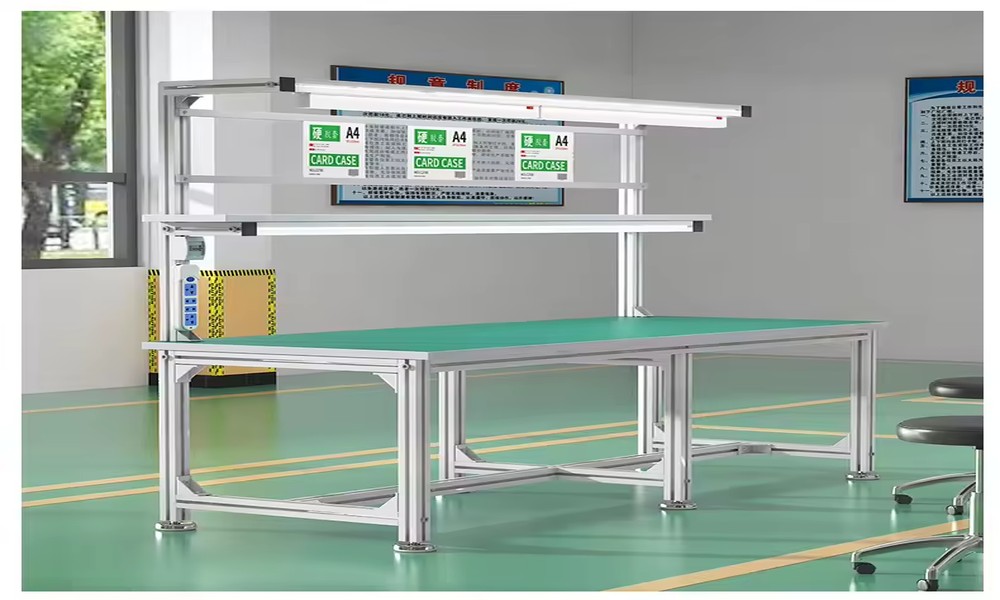

Industrial workstations are among the most frequently modified structures in any production or assembly environment. Product specifications change, operator requirements evolve, process improvements demand different tooling arrangements, and ergonomic assessments identify adjustments that need to be made. A workstation built from welded steel is largely fixed at the point of fabrication; making changes involves cutting, rewelding, and repainting. A workstation built from aluminium profile can be reconfigured in hours without specialist tools or skills. This flexibility is the primary reason aluminium profile has become the dominant construction method for industrial workstations across UK manufacturing.
The Modular Advantage
Aluminium profile workstations are built from extruded sections connected by mechanical fittings: corner brackets, T-slot nuts, pivot joints, and angle connectors that allow profiles to be joined at precise angles and positions without welding. Adding a shelf, raising the work surface height, extending the frame to accommodate new equipment, or integrating a monitor arm or tool holder all involve loosening connectors, repositioning components, and retightening. The same profiles and connectors can be reconfigured indefinitely without degradation.
This modularity also simplifies initial design and procurement. Standard profile sections and accessories from a consistent system can be assembled into almost any workstation configuration, which means the design process can start from a clear requirements brief and be realised without bespoke fabrication. A comprehensive range of aluminium profile systems and workstation components is available from UK specialists, covering profiles, connectors, worktop surfaces, shelving, cable management, and ergonomic accessories.
Ergonomics and Height Adjustability
Ergonomic workstation design is both a regulatory requirement under Display Screen Equipment and Manual Handling regulations and a practical driver of productivity. Workstations at the wrong height for the operators using them create musculoskeletal risk, reduce output quality, and increase fatigue. Aluminium profile systems support height adjustability in two ways: through the inclusion of electric or manual height adjustment mechanisms that allow a work surface to be positioned to suit different operators, and through the simple mechanical reconfiguration of the frame structure itself when a fixed height change is needed for a new process or product.
Cable Management and Integration
Modern production workstations carry power, data, compressed air, and tool connections that need to be managed cleanly to maintain a safe and efficient working environment. The T-slot geometry of aluminium profiles accommodates cable management trunking, conduit clips, and mounting brackets directly within the frame structure without the need for separate fixings or secondary metalwork. Control panels, monitors, barcode scanners, and task lighting can all be mounted on profile-compatible brackets and repositioned easily as the workstation layout evolves.
Cost Considerations
The upfront material cost of aluminium profile workstations is typically higher than equivalent fabricated steel. However, when total cost of ownership is considered including design time, fabrication, surface treatment, installation, and the cost of future modifications, aluminium profile frequently proves more economical. The absence of welding, grinding, and painting at every modification stage accumulates to significant savings over the working life of a production facility where cell layouts change regularly. Components retain their resale or reuse value at end of life, unlike painted steel fabrications which are typically scrapped.
Frequently Asked Questions
What profile series is most commonly used for industrial workstations?
40mm and 45mm series profiles are the most widely used for standard workstation frames, offering a good balance of structural strength, weight, and the range of compatible accessories available; heavier applications may require 60mm or 80mm section profiles.
Can aluminium profile workstations be designed with height adjustment?
Yes, electric and manual height-adjustable mechanisms are available as standard accessories for aluminium profile workstation systems, allowing work surface height to be set or continuously adjusted to suit different operators and tasks.
How long does it take to assemble an aluminium profile workstation?
A standard single-operator workstation can typically be assembled from pre-cut profiles and components in two to four hours by a competent fitter with no specialist tools; flat-pack delivery options from suppliers allow on-site assembly without a fabrication shop.
Are aluminium profile workstations suitable for cleanroom or food production environments?
Yes, the anodised surface of aluminium profiles is resistant to cleaning agents, does not corrode, and does not harbour bacteria in the way painted steel can if the surface is chipped or degraded, making aluminium profile particularly well suited to hygienic production environments.
Final Thoughts
Aluminium profile workstations deliver a level of flexibility, ergonomic adaptability, and long term value that fabricated steel alternatives cannot match in dynamic production environments. The ability to modify, extend, and reconfigure without specialist fabrication skills is not a minor convenience but a genuine operational advantage that compounds over the life of a production facility.
For UK manufacturers designing or upgrading workstations for assembly, testing, inspection, or packing operations, a specialist in industrial aluminium profile systems and factory solutions provides the product range and design support needed to build workstations that perform well now and adapt as requirements evolve.
